A bright, reflective window can make a home, office, or storefront feel private during the day. But when the lights come on inside, the question changes quickly: is mirror film private night? The short answer is no – standard mirror or reflective window film does not provide reliable privacy at night when the interior is brighter than the outside.
That does not mean mirror film is the wrong choice. It can still be an excellent solution for daytime privacy, heat reduction, glare control, and UV protection. The key is understanding what reflective film can do after dark, where its limits are, and which alternatives deliver the level of privacy you actually need.
Is Mirror Film Private at Night?
Mirror film works because of a simple lighting principle. The brighter side of the glass appears more reflective, while the darker side is easier to see through. During the day, daylight outside is usually much brighter than the light inside your home or building. People outside see a reflective surface, while occupants can still look outward.
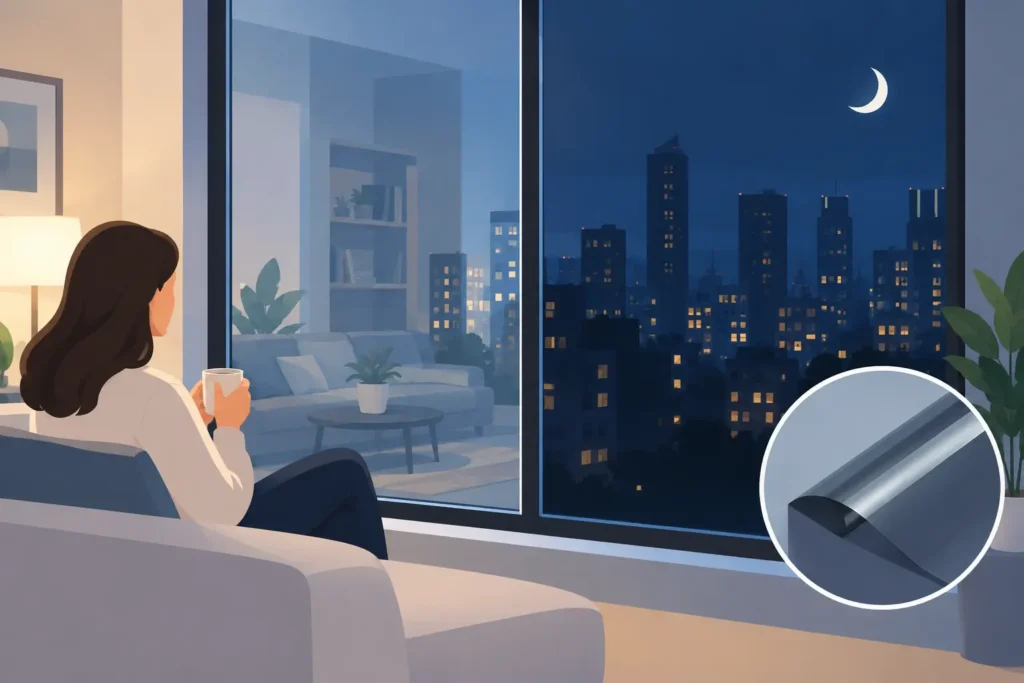
At night, that balance often reverses. Interior lights make the room brighter than the exterior, particularly in residential areas, offices after hours, and commercial spaces with illuminated displays. From outside, a person may be able to see into the room. Meanwhile, the person inside sees more reflection in the glass and less of the view beyond it.
In practical terms, mirror film offers one-way privacy only when the exterior side is significantly brighter. It is not a one-way mirror around the clock.
The result depends on the difference in light levels, the strength of the film, the angle of the window, and what is happening outside. A well-lit patio, streetlight, or floodlight can help maintain some reflection at night. But it is not a dependable privacy strategy for bedrooms, bathrooms, street-facing living rooms, or ground-floor offices where confidentiality matters.
What Mirror Film Still Does Very Well
Reflective window film remains a high-performing choice when its benefits match the space. It can reduce solar heat entering through large panes of glass, cut harsh glare on screens, and filter UV rays that contribute to fading in floors, furniture, artwork, and retail displays.
For Sydney properties with strong sun exposure, that can make a meaningful difference to comfort and cooling costs. West-facing windows, glass-heavy facades, sunrooms, offices, and shopfronts are common areas where solar film earns its place. The mirrored finish can also create a clean, contemporary exterior appearance.
Daytime privacy is another genuine benefit. If your home overlooks a neighboring property or your office faces a busy street, reflective film can limit casual views into the building while preserving natural light and outward visibility. It simply needs to be paired with another solution for nighttime privacy.
Why “One-Way” Can Be Misleading
The term “one-way mirror film” is widely used, but it can set the wrong expectation. The film itself does not decide who can see through the glass. Lighting does.
Think of a window at dusk. As the sun goes down and indoor lights are switched on, the reflective effect gradually weakens. Once the room becomes brighter than the exterior, silhouettes and interior details can become visible from outside. Sheer curtains may soften the view, but they rarely provide complete privacy under strong indoor lighting.
This matters most when privacy is not optional. A home office used for confidential calls, a treatment room, a meeting space, or a bedroom needs coverage that works regardless of the time of day. In these settings, a reflective solar film alone is not enough.
Better Options for Nighttime Privacy
The right alternative depends on whether you want permanent privacy, flexible privacy, light transmission, or a balance of all three. An experienced installer can assess the glass, sun exposure, existing window treatments, and the way you use the room before recommending a film.
Frosted and Decorative Window Film
Frosted film is often the most practical choice for spaces that need consistent privacy without losing daylight. It obscures the view from both sides of the glass, day and night, while allowing soft natural light to enter.
It is especially effective for bathroom windows, sidelights beside front doors, internal office partitions, medical rooms, and windows that face a close neighbor. Decorative frosting can be installed as a full panel, a partial band, or a custom pattern to create privacy while retaining a polished, premium look.
The trade-off is clear: you will not have an outward view through the frosted area. For many privacy-sensitive locations, that is exactly the point.
Solar Film Combined With Curtains or Blinds
For living areas, bedrooms, and offices where you want the daytime performance of mirror film and privacy at night, the best answer is often a layered solution. Reflective or solar-control film handles daytime heat, glare, UV exposure, and casual views from outside. Blinds, curtains, shutters, or roller shades provide full coverage after dark.
This approach gives you more control than choosing one product to do every job. You can enjoy daylight and views during the day, then close the window treatment once interior lights are on. It also allows the film selection to focus on solar performance rather than forcing a compromise on appearance or visibility.
Dual-Reflective Film
Dual-reflective film is designed to have a lighter, less mirror-like appearance on the interior side while retaining stronger reflectivity outside. It can improve daytime views compared with highly reflective film and reduce the mirror effect seen from inside after dark.
However, dual-reflective film does not create true nighttime privacy. It may reduce how clearly people can see through the glass in some conditions, but if the room is brighter than outside, visibility into the space remains possible. It is a comfort and appearance upgrade, not a replacement for blinds or frosting.
Blackout and Opaque Film
Where there is no need for light or visibility, opaque film provides complete coverage. It is useful for storage areas, equipment rooms, back-of-house commercial spaces, and sections of glass that expose clutter or sensitive operations.
Blackout film is not usually the first choice for a home or client-facing office because it blocks the view and natural light. Yet for the right application, it offers certainty that reflective film cannot provide.
How to Test Your Current Windows at Night
If you already have mirror film installed, test it before relying on it for privacy. Turn on the lights you normally use in the room after dark. Step outside and view the glass from the street, driveway, patio, or neighboring side of the property.
Look from several angles and at different distances. Stand close to the glass, then move farther back. Check whether silhouettes, furniture, computer screens, or people are visible. Repeat the test with exterior lights on and off, because outdoor lighting can change the outcome.
Do not judge nighttime privacy from inside the room alone. From indoors, reflections can make the glass appear more private than it actually is from outside.
Selecting Film for the Room, Not Just the Window
The best film choice begins with the purpose of the space. A street-facing living room may need heat reduction and daytime privacy, while a bathroom needs permanent obscurity. A boardroom may require glare control for screens, professional styling, and the ability to create visual privacy at any hour.
Glass type also matters. Modern windows can be single-pane, double-pane, laminated, coated, or toughened, and not every film is suitable for every glazing system. The wrong product or installation method can affect thermal stress and may conflict with manufacturer guidance. Professional assessment helps ensure the selected film is appropriate for the glass and delivers long-lasting results.
At Prestige Tinting, our expert team helps property owners choose premium window film based on real conditions – sun exposure, privacy needs, building use, and visual goals. That tailored approach avoids the common disappointment of expecting mirror film to perform like frosting after dark.
Make Nighttime Privacy a Deliberate Choice
Mirror film is a smart investment when you want a cooler, less glaring, more private space during daylight hours. But it should not be sold or selected as a complete nighttime privacy solution. Once the interior is brighter than outdoors, the one-way effect can disappear.
If nighttime privacy matters, combine solar film with quality window coverings or choose frosted, decorative, or opaque film for the relevant glass. A thoughtful film plan gives you the comfort, protection, appearance, and privacy your space needs – not just when the sun is up, but when you are living or working there after dark.